
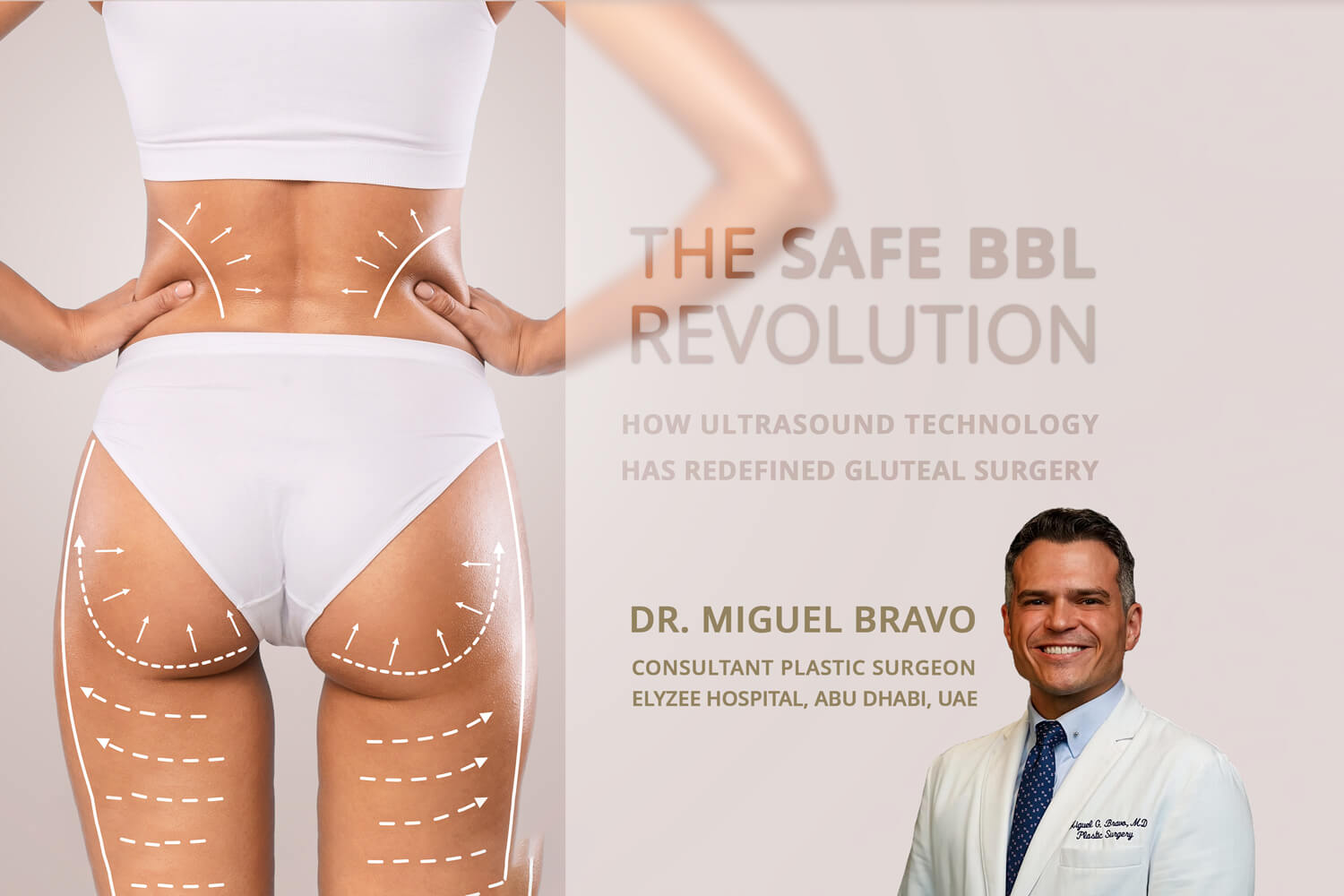


For years, the Brazilian Butt Lift (BBL) has been the most discussed—and debated—procedure in plastic surgery. It has dominated social media feeds, redefined beauty standards across the globe, and unfortunately, garnered headlines for all the wrong reasons. As a plastic surgeon specializing in advanced body contouring here in Abu Dhabi, I often sit across from patients who desire the aesthetic benefits of gluteal sculpting—the enhanced projection, the hourglass ratio, the correction of hip dips—but are paralyzed by fear regarding the safety of the procedure.
Their fear is not unfounded. Historically, BBLs carried higher risks than other aesthetic surgeries. However, the narrative that "BBLs are unsafe" is outdated. In the last five years, a quiet revolution has taken place in our field. It is not a revolution of style, but of science and technology.
At Elyzee Hospital, we do not practice the gluteal surgery of a decade ago. We practice the "Safe BBL." This modern approach is defined by a strict adherence to anatomical guidelines and, most crucially, the use of real-time ultrasound guidance. This technology has effectively turned the lights on in a room that was previously dark, allowing us to sculpt with a level of precision and safety that was previously impossible.
In this article, I want to walk you through exactly what has changed, why the "Safe BBL" is the new gold standard, and how we utilize this technology to deliver world-class results without compromising your well-being.
The Anatomy of Risk vs. The Anatomy of Safety
To understand why the modern approach is safer, we must first understand the anatomy of the gluteal region and where the risks historically came from. The goal of a BBL is to transfer fat harvested from other areas of the body (like the abdomen or flanks) into the buttocks to create volume and shape.
The Historical Error: Intramuscular Injection In the early days of this procedure, surgeons operated under the belief that to get maximum projection and graft survival, the fat needed to be placed deep into the gluteal muscle. We call this "intramuscular injection." While this often created dramatic results, it was also the source of the procedure's danger. The gluteal muscle is rich with large veins that travel directly to the heart and lungs. When surgeons injected fat blindly into the muscle, there was a risk of injuring these veins and allowing fat to enter the bloodstream, causing a pulmonary embolism.
This risk existed because, without imaging technology, surgeons were relying on "feel" alone. Even the most experienced hands could not guarantee with 100% certainty exactly where the tip of the cannula was located relative to those deep veins.
The New Standard: Subcutaneous-Only Grafting Today, the global plastic surgery community, led by safety task forces, has established a strict prohibition against intramuscular injection. The "Safe BBL" is built on the principle of Subcutaneous-Only Gluteal Fat Grafting.
This means we strictly place the fat in the "safe zone"—the space between the skin and the muscle fascia (the casing of the muscle). We never cross the border into the muscle.
- Safety: By staying above the muscle, we completely avoid the deep venous system. The risk of a major embolism drops precipitously because we are simply not operating in the danger zone.
- Aesthetics: Some critics initially worried that staying out of the muscle would limit results. This has proven false. By utilizing the subcutaneous space effectively and combining it with aggressive high-definition liposuction of the surrounding areas (the waist and lower back), we can achieve significant projection and profound shape changes.
However, a challenge remained: If a surgeon is operating blindly, how can they be 100% sure they haven't accidentally poked through the muscle fascia? This is where technology had to step in.
The "GPS" of Surgery: Ultrasound-Guided Fat Grafting
If the shift to subcutaneous grafting was the change in strategy, ultrasound guidance is the tool that ensures we execute that strategy perfectly.
At Elyzee Hospital, I utilize medical-grade ultrasound technology during your surgery. For decades, ultrasound was used primarily for diagnostics or pregnancy scans. Now, it is an essential instrument in the operating theater for advanced body contouring.
How It Works: During the fat injection phase of the surgery, I hold the ultrasound probe against the gluteal skin. On a screen next to me, I can see a real-time, cross-sectional view of your anatomy.
- Visualizing the Layers: I can clearly see the skin, the subcutaneous fat layer, the white line of the fascia, and the dark muscle beneath it.
- Tracking the Cannula: As I introduce the cannula (the tube used to place the fat), the ultrasound allows me to see the tip of the instrument inside your body. It is comparable to using a GPS or a backup camera when parking a car, versus trying to park using only your mirrors.
- Confirming Placement: I can watch the fat leaving the cannula and verify, visually, that it is expanding the subcutaneous space and not entering the muscle.
Why This Matters for the Patient: The primary benefit is peace of mind. When I perform a BBL with ultrasound, I am not guessing. I am navigating. This technology eliminates the "blind" aspect of the surgery.
- Constant Monitoring: If the cannula tip approaches the muscle fascia, I can see it on the screen immediately and redirect it to a shallower plane.
- Efficiency: Beyond safety, it allows for smoother results. By visualizing the fat pockets, I can ensure the grafts are distributed evenly, reducing the risk of lumps or irregularities.
This technology is currently the differentiator between a standard practice and a center of excellence. While it requires significant training and investment to master, I believe it is non-negotiable for modern gluteal surgery. It allows me to tell my patients, with confidence, that we have taken every variable under our control to ensure their safety.
The Elyzee Protocol: A Holistic Approach to Body Contouring
While ultrasound technology is the headline feature of the "Safe BBL," a successful surgery is not just about the injection technique. It is about the entire ecosystem of care. At Elyzee Hospital, my protocol for gluteal surgery is comprehensive, focusing on the quality of the result and the speed of your recovery.
- High-Definition Sculpting (The Frame): A beautiful gluteal region is not just about volume; it is about the frame. You cannot have a masterpiece painting in a broken frame.
- I focus heavily on Lipo-Sculpting the waist, flanks (love handles), and the sacral area (lower back). By aggressively contouring these areas, we create a "shelf" for the glutes. This makes the buttocks appear more projected and lifted, even before we add a single drop of fat.
- For male patients, this approach is modified to maintain a masculine, athletic silhouette, avoiding an overly feminine hourglass but enhancing the lateral depression to create a muscular look.
- Fat Viability and Processing: The longevity of your result depends on how much of the transferred fat survives. Fat cells are fragile. If they are mistreated during harvest, they will die and be reabsorbed by the body within months.
- We use gentle, power-assisted technologies to harvest the fat, ensuring the cells remain viable.
- The fat is then processed in a closed-loop system to remove oil, blood, and fluids, ensuring that only pure, healthy gold-standard fat is injected. This maximizes the "take rate" (the percentage of fat that stays permanently).
- Post-Operative Care and Lymphatic Drainage: The surgery is only 50% of the result; the recovery is the other 50%. Our protocol includes a strict regimen of compression garments and lymphatic drainage massages.
- Because we work in the subcutaneous plane, swelling can be significant. Immediate and consistent lymphatic drainage is crucial to prevent fibrosis (hardening of the tissue) and to ensure the skin retracts smoothly over your new contours.
- We guide you through the "fluffing" period—the 3 to 6 months post-surgery where the skin relaxes and the final shape reveals itself.